
If you’ve driven through Fall City recently, you may have noticed construction activity behind some local businesses. It’s part of a major infrastructure upgrade: the long-awaited on-site community septic system for the Fall City business district.
Since our November update, crews have installed and connected more than half of the septic tanks (40!) to the underground treatment plant. The project remains on schedule for completion in Summer 2026, a milestone that will support existing businesses and allow them to fully use their buildings to serve the community.
We spoke with two local business owners about what this project means for them—and for Fall City.
Aroma Coffee Co.: A vision years in the making
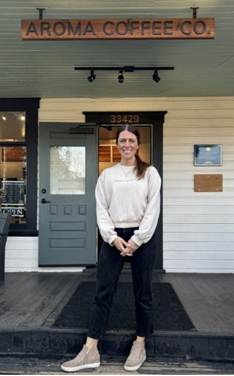
Sara Cox, co-owner of Aroma Coffee, knows how septic challenges can shape a business. “Our vision for a community-centered coffee shop in Fall City started in 2007,” she said. “We wanted a place that was the heartbeat of the community—a neutral spot where anyone could feel welcome.”
Turning that vision into reality took time. The building that now houses Aroma had been out of code for years because of an outdated septic system and thus sat empty. When the Nelson family of Nelson Treehouse partnered with Aroma, they faced a lengthy process of advocacy and permitting before finally securing approval to replace the septic system in 2020.
Then COVID hit. “We asked ourselves, ‘Is this a good time to open?’ The answer was yes. People needed a community spot,” said Sara. Aroma Coffee opened during the pandemic and quickly became a gathering place for neighbors. Today, it’s thriving—on a recent Friday morning, every table inside and out was full.
The only sign of disruption now is the back garden, closed and surrounded by orange tape due to septic work. That space has served as an informal community park, and the owners are seeking funding to restore it for events and rentals. Looking ahead, Sara is optimistic: the new business district septic system will support a commissary kitchen next door, boosting Aroma’s food sales. “It’s not a question of if we needed a new septic system—it was how and when,” she said.
Studio 202: Peace of mind after years of challenges
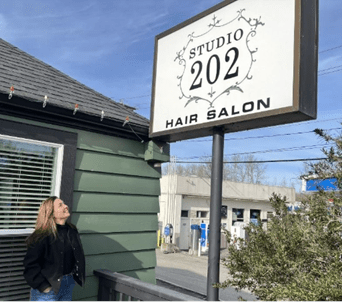
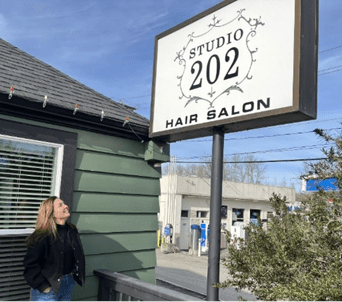
Sarah Keiffer, founder and owner of the popular Studio 202, took time from her busy day to share details of the importance of clean water and working septic systems. She remembers when septic issues were a constant concern for the business district.
“Some businesses had to pump their septic systems weekly. Other businesses had to close because their systems simply failed or they couldn’t meet code,” Sarah said.
This year, Studio 202 celebrated its 20th anniversary. Sarah has seen the evolution from renting a small studio to owning her own building. As a property owner, the new system means peace of mind. “Yes, there will be an added cost, but it’s worth it,” she said.
As a board member of the Fall City Community Association and a member of the Fall City Septic Association, Sarah understands the details—and the concerns. “People worry the drainfield is too close to the river,” she said. “But the system is designed to clean and filter water to the highest quality regulated by the state, so this project is an overall improvement to water quality in our rivers.”
Her involvement in local issues was inspired by her late father’s activism and a desire to give back once her kids were grown. “Fall City runs on volunteer power,” Sarah said. “We care—and that fuels everything.”
Looking ahead
A reliable septic system may not be the most visible improvement, but it is essential for a thriving business district. It means new businesses can open, existing ones can thrive, and the community can maintain its small-town character while growing sustainably.
By Summer 2026, the orange tape will be gone, gardens will be restored, and Fall City will have the infrastructure it needs to flourish.
Learn more about the project here: Fall City on-site community septic system – King County, Washington.
 King County Local