
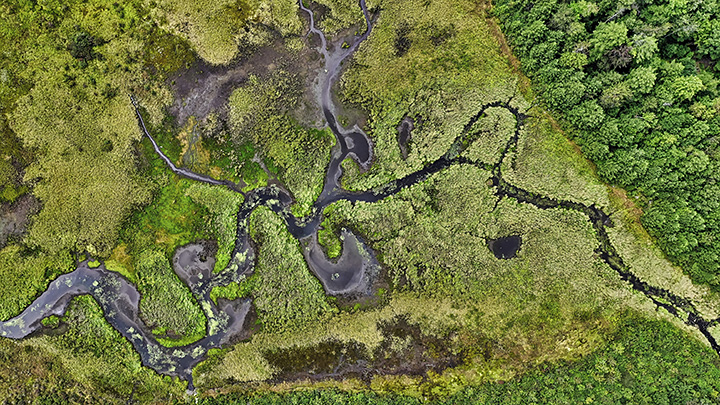
King County has completed the first major update in two decades of its regulations for developing land near wetlands, streams, and other critical areas.
Developed through three years of research, planning, and public discussion, the updated King County Critical Area Ordinance is a set of land use regulations intended to safeguard environmentally critical areas, communities, and infrastructure.
The Metropolitan King County Council adopted the final ordinance on Dec. 2. Please continue reading for more information on when the ordinance becomes effective, frequently asked questions, next steps, and updated permitting guidance.
What’s a critical area?
The term “critical area” refers to land that merits special protection because of its ecological value or importance to public health or safety.
Wetlands, streams, riparian areas, fish and wildlife habitat conservation areas, frequently flooded areas, and critical aquifer recharge areas are all examples of critical areas.
Geologically hazardous areas also fall under this definition, including landslide, erosion, and seismic hazard areas.
Key updates include safer development standards, clearer standards, and flexibility for certain uses
Updated regulations are informed by the best available science and strengthen protections for water quality, habitat, and public safety. At the same time, the updates clarify regulatory flexibility for developing housing and services in urban areas and ongoing commercial agriculture.
Key changes include:
- Strengthening water quality and habitat protections – Increased protections for native trees and vegetation along rivers, streams, and wetlands.
- Preventing harm – Clearer standards to avoid, minimize, and mitigate for development impacts to wetlands and streams.
- Flexibility for housing and services in urban areas – Updated standards to support development of housing and services like childcare centers in urban areas.
- Clarifying guidelines for agriculture – Ensuring that regulations recognize and support established, ongoing commercial agriculture informed by Farm Management Plans.
- Enhancing public safety – New standards for keeping people safer in tsunami and alluvial fan hazard areas.
- Adapting to a changing climate – Developing criteria for selecting native species that are well suited to our changing climate when planting habitat restoration and mitigation projects.
Fulfilling our commitment to support a growing population while protecting our environment and agriculture
Like all local governments, King County is required through the Washington State Growth Management Act to adopt critical area regulations, ensure that new development doesn’t cause a net loss of habitat and ecological functions, and provide additional protection for salmon.
At the same time, local governments must address state Growth Management Act goals to support housing, infrastructure, agriculture, and forestry.
When we make these updates, we’re required by state law to use what’s called “best available science” when developing policies and regulations for protecting critical areas.
This means we’re using the most up to date and credible science and state guidance when creating and updating policies and development regulations. You can read the full Best Available Science Report here.
Impact of environmental protections
There’s recent evidence that shows stream health has been improving in King County since it started applying critical areas and stormwater regulations, despite the significant population increase and landscape development over the past two decades.
Researchers suggest that improvements in stream water quality – demonstrated by healthy populations of aquatic insects that can only live in clean water – could be the result of protective critical area, stormwater, and forestry regulations at the regional scale.
Additionally, a recent King County study found significant improvements in Lake Washington’s water quality between 1998 and 2022 even as the watershed’s population grew by 34 percent.
Multiple environmental protections likely contributed to this progress, including stormwater upgrades, erosion controls, transitioning homes from septic systems to the regional sewer system, and helpful actions of watershed residents.
When do the regulations go into effect?
The effective date for the ordinance is Feb. 18, 2026. For critical areas located within the shoreline jurisdiction, the Washington State Department of Ecology must review and approve King County’s regulations before they can go into effect. The shoreline jurisdiction includes all shorelines, shorelines of statewide significance, shorelands, and the 100-year floodplain. The updated critical area regulations for the shoreline jurisdiction will go into effect 14 days after King County receives Ecology’s approval. There is currently no estimate for when Ecology will complete its process.
Permit applications for new development are typically reviewed based on the regulations effective at the time the application was deemed complete. Current CAO updates also clarify grandfathering for certain ongoing agricultural activities that are already in compliance with code.
What happens next?
The County Code Reviser is updating the King County Code to include the recent changes adopted by the Council.
We heard loud and clear that plain language summaries are very important to our customers. The Permitting Division is updating critical areas customer bulletins to reflect the updated requirements by mid-February and training staff to answer questions about the updates.
King County Department of Natural Resources and Parks is coordinating the update to the Farm Management Plans Public Rule, which provides guidance for development, implementation, monitoring, and enforcement of farm management plans obtained by farmers to receive regulatory flexibility. The revised Public Rule will be adopted by the end of 2026. For more information on the Public Rule update, please contact Richard.Martin@kingcounty.gov.
Additionally, the County will develop criteria for use of “climate-adaptive plants” and publish a plant list by the end of 2026. Please stay tuned for more information on opportunities for input.
For more information on the CAO updates, including how these changes may impact agriculture, please see our FAQ here: Critical Areas – Overview and related permits – King County, Washington.
 King County Local