
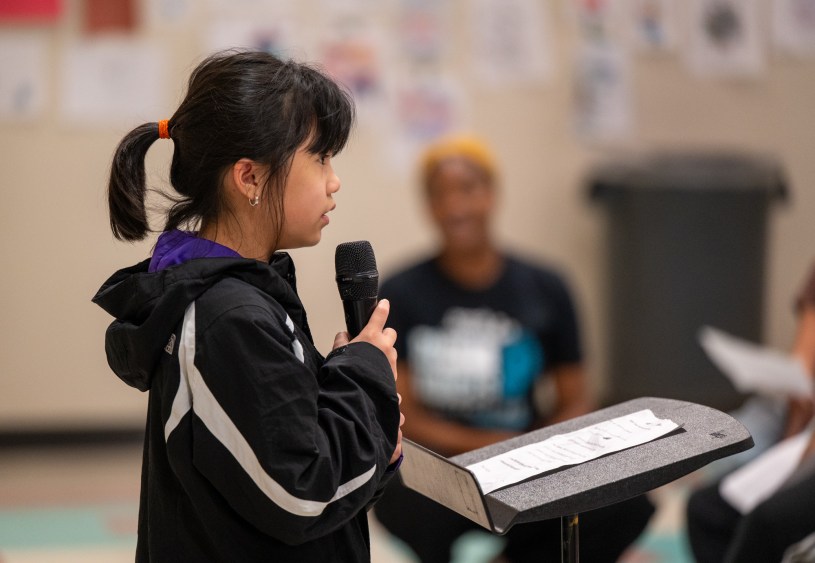
The girl inched close to the microphone with a straight face and scanned the cafeteria-full of people fixated on her.
In an instant, the Lakeridge Elementary fifth-grader’s face lit up with a burst of confidence and determination.
“Raise your hand if you want to prevent suicide,” she said, prompting hands to spring up across the seated audience.
The girl was speaking from experience. She had been bullied and even once felt she’d be better off gone.
“Sometimes people feel like it’s their only option,” she reasoned. “I want to help people realize there’s more to life than negative things. Negative things can help steal your life away and make you feel like you want to end your life.”
“Don’t. It will only cause more damage than it will fix. Suicide is a forever answer to a current problem.”
The student’s words were powerful, but the significance of her speech was as much about the journey she took to deliver it – a journey that was made possible by Speak With Purpose and the King County Department of Local Services’ Participatory Budgeting program.
Speak With Purpose is a public speaking program offered directly in classrooms throughout King County, and the Skyway-based group aims to amplify the voices of young people in underserved communities. It was one of 40 projects and programs in urban unincorporated King County that the community chose to support through Participatory Budgeting.
The community of Skyway – one of the most culturally diverse in the state – voted to direct $96,000 in public funds to Speak With Purpose to deliver sessions at low-income schools for students in the fourth-through-eighth grade that take place during the school day.
The program started off at one school in 2021. Thanks to the Participatory Budgeting process, it has grown to four schools in Skyway: Lakeridge, Bryn-Mawr and Campbell Hill Elementary Schools, as well as Dimmitt Middle School.
“It is such an honor,” said Krystal Smith, the group’s Director of Education. “I live in this community. I am part of the Skyway community. My kids go to this school. That is a really big deal to me that the community said they wanted us here.”
For Participatory Budgeting Program Manager Gloria Briggs, witnessing the impact Speak With Purpose and other community-chosen efforts have in the Skyway classrooms gives her a deep sense of pride.
“It is inspiring to witness the program’s growth and expanded reach as a direct result of PB funding, allowing it to positively impact more students,” she says. “This investment demonstrates how Participatory Budgeting is meaningfully shifting decision-making power to the community, enabling residents to determine how resources are allocated to best serve their needs.”
Different students, same message
This year, Speak With Purpose is working with Lakeridge’s entire fifth-grade class.
Organizers met with Principal Carlito Umali, a Skyway native “who really wanted the fifth-graders of Lakeridge to have more leadership opportunities.” He was also one of the people in the audience during the recent presentations.
Smith says the students have different learning needs. Some struggle with social anxiety. Others are perfectly capable with classwork but are unwilling or unable to speak in front of people. Some students recently moved to the U.S. and are learning English, often the case in a diverse community such as Skyway.
No matter the circumstance, Smith says she delivers the same message to students the first time they meet as a group.
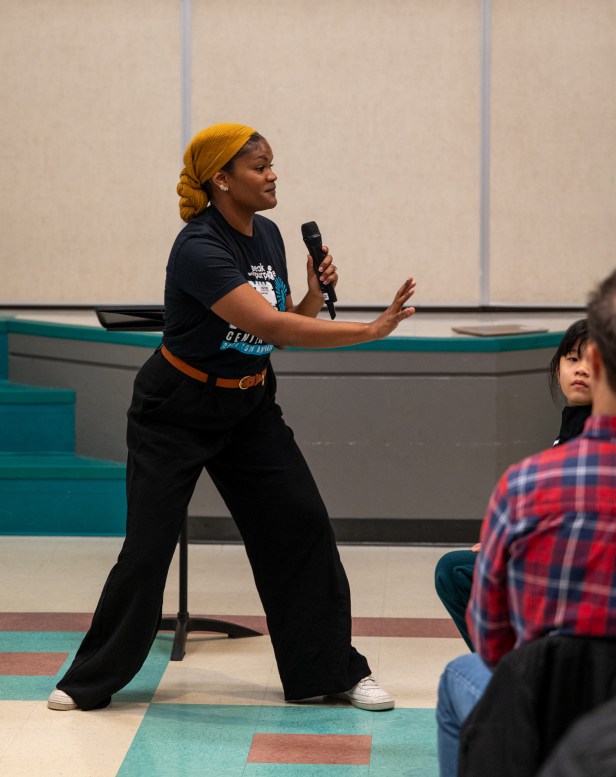
“I look at every one of them on the first day, and I say, ‘We’re not going to sugarcoat this – at the end of this 15 weeks, you all are going to get up there and speak,’” she said, admitting some students are initially shocked.
“With giving a speech,” she maintains, “everybody knows how to talk and be personable. It’s easy for everybody to be successful with enough practice. We work with every kind of learner.”
Personal story
This semester, Speak With Purpose (Smith and two interns from the University of Washington) delivered culturally responsive instruction and guidance to some 20 students at Lakeridge.
Each session was an hour per day, for 15 weeks, during what would typically be classroom writing time. These sessions were designed to equip students with communication and leadership skills, as well as provide a safe place to practice speaking in front of fellow student-learners.
For this batch of budding elementary orators, the sessions culminated inside the Lakeridge Elementary cafeteria in front of about 50 spectators (mostly parents and educators) lending their support. Each speaker walked to the microphone, took a moment to center themselves, then presented a personalized monologue about what they’d like to see changed in the world, an effort that organizers coined as a “Passion Piece.”
The topics ranged from serious, thought-provoking issues such as gun violence, immigration enforcement and suicide; to lighter matters more typical of elementary school-aged youth such as longer recess breaks and improved conditions on their school’s soccer pitch.
Whatever these students stumped for, it mattered to them.
“They had to share a personal story from their lives,” Smith said. “These are things that the kids are facing. By simply saying, ‘You get to share your story and your perspective on something,’ really helps the kids see the importance of why their voice matters.”
With guidance from Speak With Purpose, the students spent weeks preparing to deliver their speeches in just the right way.
“We rehearsed with them,” she said. “We worked on voice projection, eye contact, hand gestures, and how to stand up with confidence, even when you’re feeling nervous.”
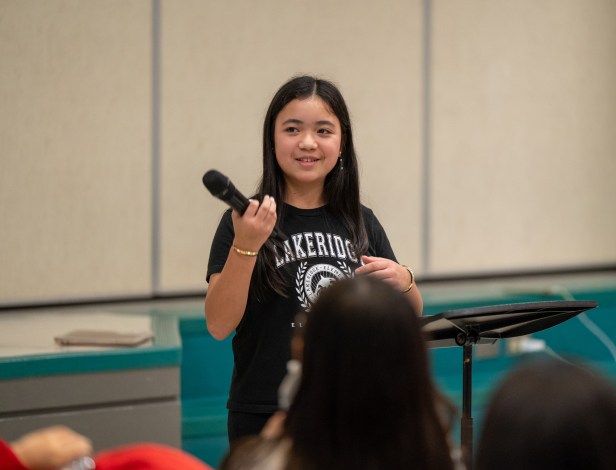
“‘I can stand up here“
One by one, the students walked to the front of the crowd and delivered their speeches.
Some were boisterous, others not. Shoulders were back, and there was lots of eye contact with the audience. No tears. Nobody ran off stage.
Those are all considered wins for Speak With Purpose, although for Smith the biggest indicator of success typically comes after each speech.
“Do they have a big smile?” Smith asks. “Once they get that first speech out, they’re like, ‘Oh, I can be a leader. I can stand up here.’ Everybody is here to support me. No one is here to laugh at me or boo me off the stage, which is what everyone thinks.”
“It’s a feeling of relief, that they worked through their emotions.”
Word is spreading in Skyway about the foundation that Speak With Purpose continues to build. Educators have seen improvements in students, as have their families.
It also illustrates the importance of resource support from the community that Participatory Budgeting delivered. “This continued partnership – the schools want us here,” Smith says. “The parents want us here. We want to be here. This is all made possible because of Skyway Participatory Budgeting.”
“Passion Piece” examples
Below are some examples of what Speak With Purpose students presented for their Passion Pieces:
When you leave today I want you to not listen to what people say about what each gender should wear. The problem is people deciding what each gender should wear according to their gender and what they can’t wear. I plan to keep wearing whatever I want. Wear what you want. To the adults, help those people who think that you should wear certain things because of your gender understand that it’s okay to wear what you want. To the kids, if one of your fellow classmates or friends think we should wear things if you’re a certain gender, educate them, tell them it’s okay to wear what you want. This will make it so there will be less disagreements and more peace. Please keep this in mind. – Bella, speaking about clothing expectations based on gender
I was at recess and I was playing soccer and I was dribbling and I was about to shoot and then the bell rang and the people on the pitch and I was confused because recess felt so short and I was a little mad because the goal didn’t count so I was sad, mad, annoyed, confused because recess was so short and Mr. Orange said, “Dang!” That recess was short and we didn’t even get 15 minutes because the bell rings at 14 minutes and 14 minutes compared to hours of math, reading, writing and science and doing all of that for hours gets me stressed out, so I say we need way more recess time. – Bruce, speaking about the need for more recess time
I remember when I was outside with my friends I heard gun shots. I was scared because I didn’t know what to do so I tried running home, but they were shooting over there so I couldn’t. I was scared and I didn’t know what to do so I looked for a hiding place. I ran to a good hiding place. Then I waited for 15-23 mins with my phone, then I saw the cops, so I asked them if it was done and they said yeah. I think we should stop gun violence and live the way we want, and I think we should change the age to get a gun to 25 years old. Please spread the word to stop gun violence. – unidentified student, speaking about reducing gun violence
And the problem is that I don’t have a phone in case of an emergency. I can’t call 911 if anything bad happens. I can ask my parents to get a phone and be more respectful to my parents by saying please. I can also try to be more responsible by doing more chores and doing my homework early. Parents, you should change your rules so that your kids can get a phone at 10 years old. – Abdi, speaking about the reason parents should allow their kids to carry cell phones
This problem is that some kids want to end their lives and leave their family and friends. I want to make sure that people feel welcome so that people don’t feel like it is right to have to end their life. And it is not okay for teens, adults, kids and small people to end their lives.. It matters that people need to live. If you kill your self now you won’t get to see the Beautiful world that might be in your future. – unidentified student, speaking about the importance of suicide prevention
The problem is that students are getting yelled at over small things. I know handling a bunch of kids is hard but there is no need to yell if it’s just because a kid said one word to another kid. I’m trying to change that because some students like to have fun and play. Others take school seriously and work as hard as they possibly can. Students, if you have the chance ask your teacher or a staff member. Maybe you won’t get yelled at as often. – unidentified student, speaking about the need for schools to be less strict given the long school day
 King County Local