
It’s always good when we get to share our passion with the next generation of world changers!
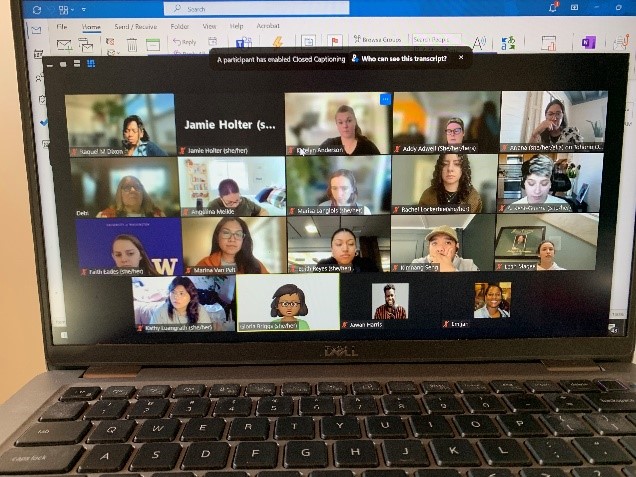
Last month, Participatory Budgeting Program Manager Gloria Briggs got the chance to do exactly that. Gloria delivered a presentation on the Local Services’ Participatory Budgeting program to students involved in the University of Washington’s School of Social Work.
This was Gloria’s second invitation to speak to the What, Why and How of this community-focused program.
By way of quick background, Participatory Budgeting began in Brazil in 1989. It is a democratic process in which community members decide how to spend part of the public budget. The program’s impacts include:
- Increased civic engagement.
- Stronger and more collaborative relationships between residents, government and community organizations.
- Creating new community leaders and increasing civic engagement of Black, Brown and other communities of color, and showcasing funded projects.
- Delivering more equitable and effective public spending.
More than 7,000 communities worldwide now use Participatory Budgeting, including Los Angeles, Tacoma and Durham, North Carolina.
Our UW audience was a mixture of master’s degree students, leadership program mid-career professionals and nursing program PhD students. The class is focused on finance and administration. These are the real next-gen leaders!
Gloria’s presentation included a quartet of past and present Participatory Budgeting steering committee members, who shared their roles and how the program changed their lives:
- Debi, a white woman from Renton, said she learned much more than expected about process and, more importantly, community disparities and equity, as well as how to see the world through another’s eyes.
- Jawan, who represents Skyway, joined the program when he saw a tattered flyer for the program on a bus stop. Despite the flier’s appearance, he called, got connected and, within a year, made his dream come true. He is now the CEO of Kings Dream Consulting, which implemented the Shop Skyway program with PB funding. It is a local non-profit that supports business owners with useful, free tools to grow their business into a reality.
- Kimnang is a White Center resident who called on a whim and ended up opening the door to the entire Cambodian community in a way no one else could. His pride was visible.
- Emijah spoke of the importance of promoting racial equity with cannabis tax revenue funding.
Students and professor were engaged, as the presentation hit home with real people participating and sharing their story about the multi-layered value of Participatory Budgeting. Professor Cantu reminded students that these programs are available to implement and participate in as a resident. She said it is another level of connection to engage with community.
King County is in its second cycle of Participatory Budgeting. Five urban communities are currently deciding how to spend $12 million on capital projects and ongoing programs. Recently, an international master’s degree student studying the implementation of the program across the globe said the King County program was one of the most well-developed he’d ever seen.
In other words, our communities make this work, and we are proud that we are able to share our success with the next generation of leaders.
 King County Local