

(The following article was written by Kate Grossman and published in the Fall City Neighbors newsletter)
Commercial and residential growth; our rivers, parks, and aquifer; the impact that local residents can have on County decisions: these are some of the hot topics in Fall City today, and the Fall City Large Onsite Septic System (LOSS) project touches them all.
Although the project is getting the attention now, the need for a wastewater solution in Fall City’s business district was created well into the last century. When State Route 202 was constructed across the plats of Fall City’s business district and commercial lot sizes decreased, many of the businesses moved on top of or near their existing septic drain fields. “If every business [today] had enough room, then we wouldn’t have a problem,” explains Fall City Capital Program Manager Jeff Wilson, who is spearheading the project. But that isn’t the case.
About ten years ago, many downtown businesses were put on notice for their septic problems and were in danger of being shuttered. With advocacy from residents of Fall City and King County Councilwoman at the time, Kathy Lambert, a temporary stay was put in place while King County and local business owners looked for a wastewater solution.
One possibility was a sewer system and sewage treatment facility, but the price tag and ongoing maintenance costs were too high. Only commercial properties in the business district would be allowed access to a sewer hookup, and at a cost of more than $23 million, plus thousands of dollars per business each year in maintenance fees, the sewer project was infeasible. Something else had to be done in order to bring current businesses up to code and enable them to continue operating.
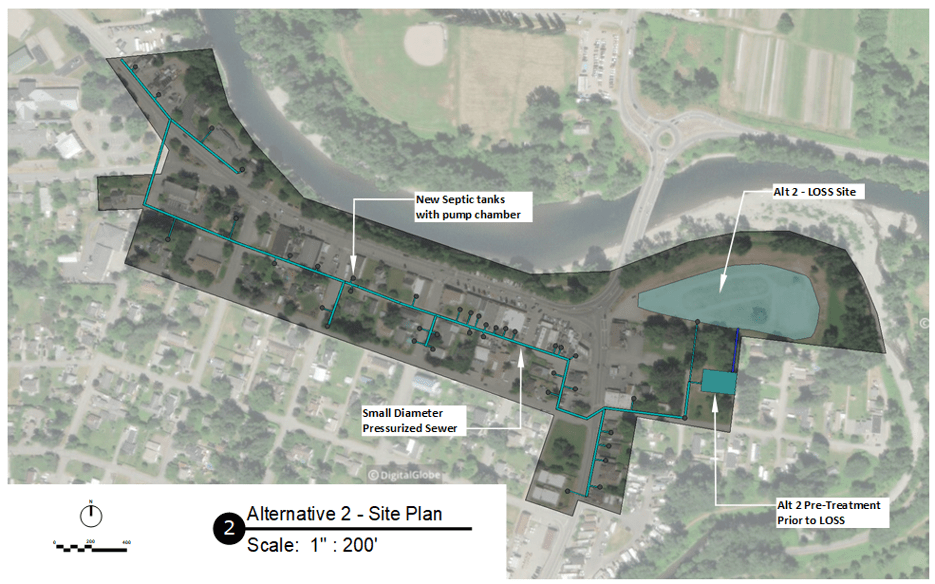
A new proposal, years in the making, is now coming to fruition: the LOSS is an alternative wastewater treatment system, rather than building a centralized municipal sewage treatment plant. The system will begin with individual septic tanks on each commercial lot. Wastewater will be conveyed from the business district to underground tanks housed on property adjacent to Bernard Park and then be leached into a drain field in Bernard Park itself. Both the properties for the treatment tanks and Bernard Park are owned by the Fall City Metropolitan Parks District.
Perry Wilkins, a founding Fall City Parks District commissioner, first allowed Bernard Park to be considered for the drain-field site. Says Pete Nelson, head of the Fall City Septic Association, “[Perry’s] extraordinary act opened up the real possibility of a desperately needed solution to our downtown septic woes.”
The LOSS will be paid for through a $6.5 million grant from the Wastewater Treatment Division of King County, as well as additional money from the State Capital Fund. These were received via the state from the American Rescue Plan Act with support from State Senator Mark Mullet and State Congresswoman Lisa Callan. The supplementary funding from the State Capital Fund will help cover design and installation. John Taylor, King County’s Director of Local Services, has also championed the project.
Even with all the government involvement, once the system is built out and operational, King County will hand ownership and operation of the utility to the owners of the business district, who formed a private nonprofit entity, the Fall City Septic Association.
As with any wastewater project, particularly for a community built on the banks of two rivers, environmental concerns are being addressed. The project will be an improvement on the current systems, says Jeff Wilson: “We don’t know the level of treatment provided to the water by those [older] septic systems. We’ll be treating to the highest level possible, which is near drinking-water standards, and that’s even before it goes back in the soil.”
Development and growth are also top of mind concerns for the project and whether or not any growth will change the town’s rural character. “This is being treated as a repair to existing systems and has a very conservative growth approach to it,” says Wilson. When existing business owners were estimating the amount of wastewater capacity they would require in the future, they chose the “low growth” scenario.
Many of the new residential developments also utilize LOSS systems in their proposals. However, Mike Suezle, representing Fall City Sustainable Growth, tells Neighbors, “Most of the proposed [residential] developments are inside the Critical Aquifer Recharge Area (CARA) for Fall City Water District wells. The business-district system is far outside the CARA.” Thus, FCSG believes the business-district system “models responsible engineering practices like requiring high levels of effluent treatment and a drain-field location that was specifically chosen because it is outside of our wellhead protection areas.”
The project is waiting on final permits before soliciting bids and beginning construction, with the goal of breaking ground before the end of this year. Once construction begins, the County expects it will take about 18 months to complete the LOSS. “Part of the extended timeline . . . is constructing a brand new utility around an existing town and connecting existing structures,” says Wilson. Fall City residents and businesses should see minimal impact, since the sewer line will be constructed through the alley behind the businesses, and none of the main roads will be closed. Parts of the shoulder of SR-202 or Preston-Fall City Road might be closed temporarily, but the County does not anticipate businesses will need to close, nor will any parking be restricted.
Pete Nelson sums it up: “What does this mean for Fall City? It assures us that all of our downtown Fall City dreams can occur. Before the LOSS system there was no way to even begin to dream. Any building or remodeling project in downtown Fall City was dead on arrival due to our inability to show a viable septic system. Now all of that will change.”
 King County Local